

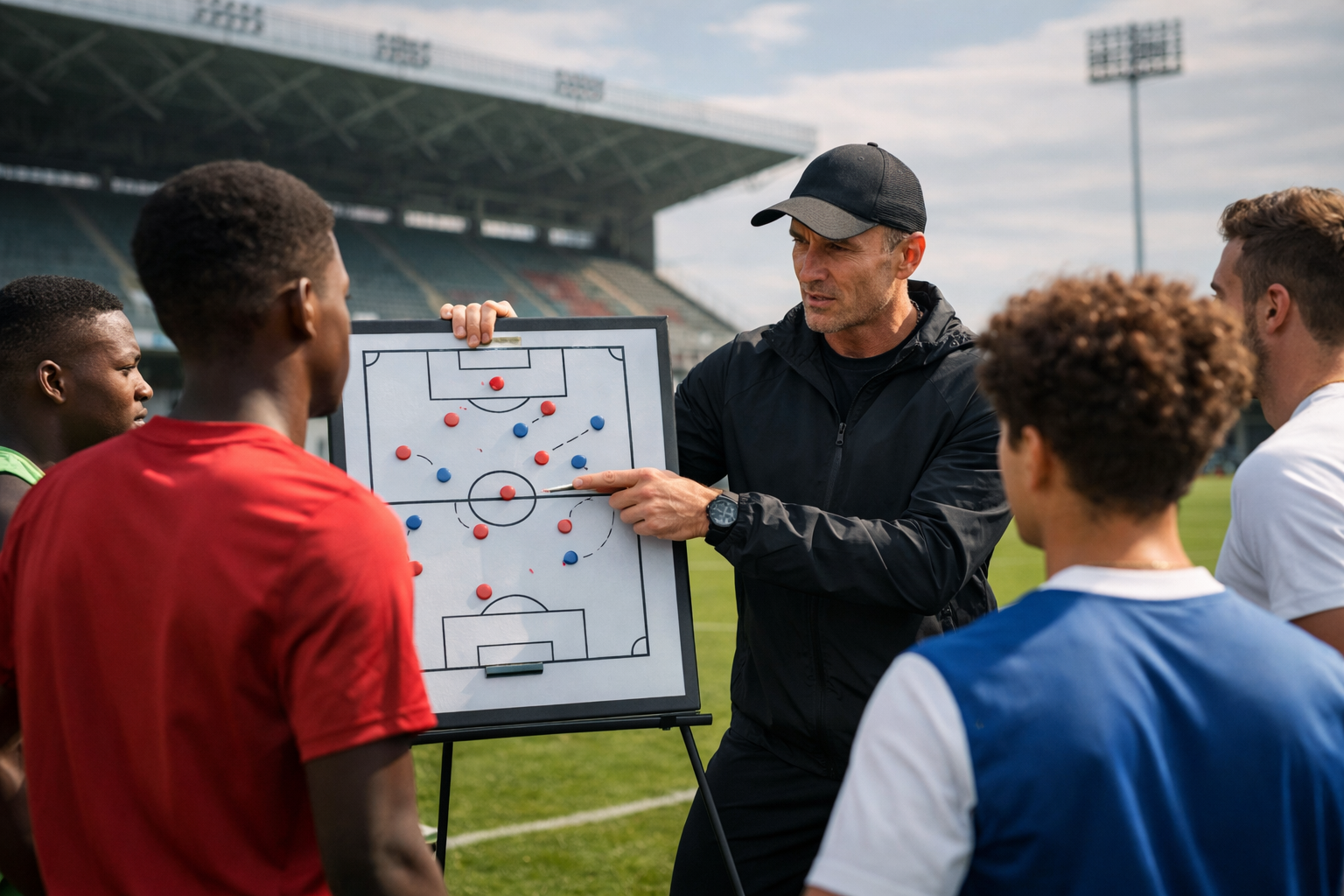
Football has always loved the myth of the lone genius: the prodigy who floats above tactics, the manager who “just knows” when to change a game. In 2026, that myth still sells posters, but it no longer explains results. The modern game is too fast, too analysed, too crowded with detail. Success is increasingly built like architecture: a clear structure, shared principles, and training that turns decisions into muscle memory. The next generation of winners won’t be defined only by who runs faster or shoots harder. They’ll be defined by who understands the game sooner, who repeats good choices under pressure, and whose teams can stay organised when the match becomes messy.
The touchline stopped being theatre
The best coaches now behave less like performers and more like system designers. Pep Guardiola’s Manchester City and Mikel Arteta’s Arsenal made it normal for elite teams to speak in the language of spacing, triggers, and “where we want the ball to go next.” Jürgen Klopp’s Liverpool era made pressing feel like choreography rather than chaos. Carlo Ancelotti showed the other side of the craft: a structure that doesn’t suffocate talent, a calm hand that keeps stars functional inside a plan.
This isn’t about copying a famous name. It’s about adopting the mindset: coaching is a repeatable process. The next generation of success belongs to clubs and national teams that build staff depth, clear roles, and training sessions that look like the match.
“Rest defence” is the new power word
If the last decade taught fans to talk about pressing, the current decade is teaching them to talk about what happens behind it. UEFA’s technical observers at EURO 2024 highlighted how teams protect themselves while attacking, describing “rest defence” as the structure that stays ready for transitions. When possession is lost, the best sides don’t panic because their shape has already planned the emergency.
The point is brutal: modern football punishes sloppy ambition. You can attack with five, but you must be stable with the players who remain. The teams that master this look both brave and safe, which is rare. They win duels in the open field, but they also win the invisible duels: the positioning choices that stop counters before they become highlights.
Academies teach decisions, not tricks
Youth development used to focus on technique as if technique existed in a vacuum. Today’s top academies treat technique as a passport, not a destination. What wins at the senior level is decision speed: scanning, choosing, executing, and resetting without drama.
That’s why the most respected production lines, FC Barcelona’s La Masia, Ajax’s long tradition, and newer projects like Right to Dream in Ghana, are obsessed with habits, not only skills. Players are trained to recognise patterns: when to break a line, when to recycle, when to press as a unit, and when to protect the centre. The next generation succeeds because it arrives already fluent in the game’s grammar.
When structure becomes a price
Betting markets don’t care about romance. They care about probability, and probability is shaped by structure. A well-coached team can be recognised before the table fully reflects it: consistent chance creation, stable defensive distances, and substitutions that strengthen rather than scramble the plan.
Fans often build their view around repeatable signals: shot quality trends, game-state management, how a team behaves after scoring first, and how it protects a lead without retreating into fear. Many also run a second screen for live stats and coefficients because markets move quickly when line-ups drop or when the first ten minutes reveal a tactical surprise. Those who want a straightforward mobile flow download MelBet (Arabic: melbet تحميل) to keep odds visible while tracking the match’s shape on live dashboards. That kind of setup rewards discipline more than bravado, because the real edge is often knowing when not to act, especially when the noise is loud, and the sample is small.
Performance science
Modern coaching isn’t only tactics; it’s availability. The best plans in the world collapse if key players arrive injured or half-fit. That’s why load management, recovery planning, and training periodisation are now central to competitive advantage, not optional add-ons for rich clubs.
FIFA’s own analysis work around the 2022 World Cup made a wider point that applies in domestic football too: physical output has context, and teams need to understand not just what players do, but when, how, and why they do it. The next generation of successful teams will be the ones that train at the right intensity, not simply the highest intensity. A player who stays sharp for 40 matches is more valuable than a player who looks brilliant for ten and then disappears into rehab.
The next winners will be the best communicators
Structure only works when it’s shared. Teams that win sustainably don’t rely on one tactical genius; they rely on collective understanding. That means clarity in video sessions, simplicity in principles, and training that rehearses game moments until they become familiar.
This is also where leadership changes. The next great captains are often translators: players who can carry the coach’s idea onto the pitch in real time. When football gets frantic, language matters. A team with shared cues stays calm while the opponent argues with itself.
What does this mean for Nigeria’s next step
Nigeria’s talent has never been the question. The opportunity now is to build a system that makes talent more predictable: stronger coaching education pathways, better alignment between academies and senior football, and league structures that protect development rather than interrupt it. Clubs like Enyimba and Rangers International carry deep tradition, while newer projects and more professionalised setups across the domestic game point toward a future where “local” doesn’t mean “temporary.”
The next generation of Nigerian success will be boosted most by a structure that travels. Not a single wonderkid, but a pipeline. Not one brilliant match, but a repeatable identity. Football rewards the nations that learn to manufacture calm.
Discussions (0)