

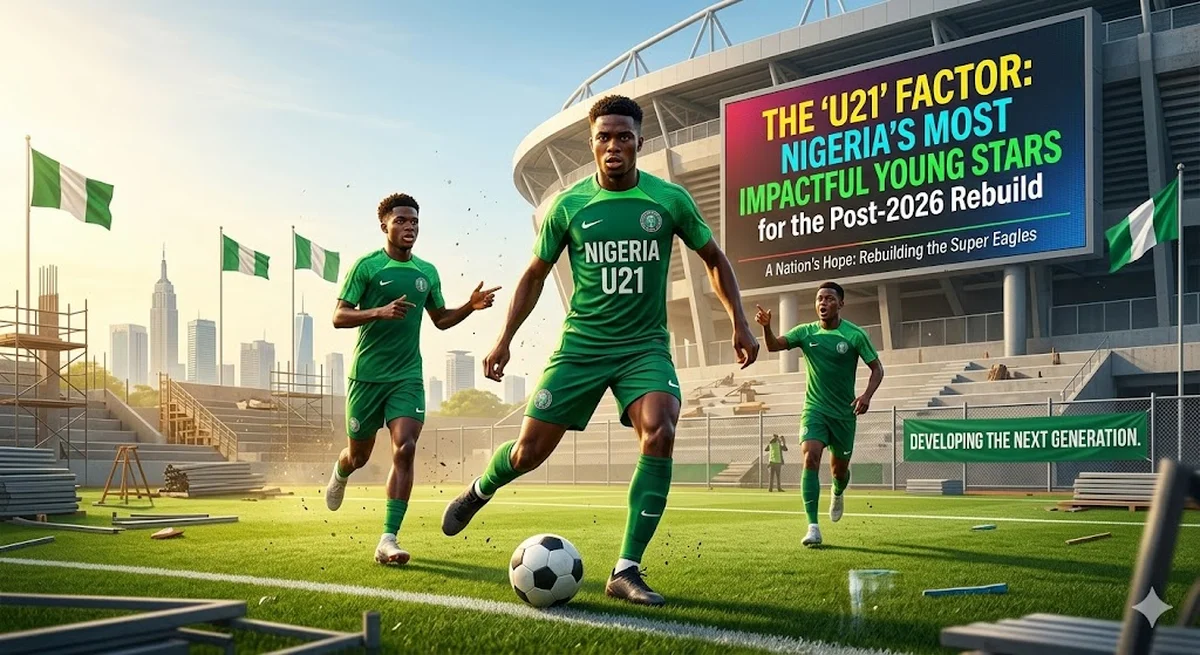
The world footballing ecosystem is in one of its most radical paradigms. For decades, the discourse around African football—and more precisely, the historical path of the Nigerian national football team—was marked by tales of brute, unrefined physical supremacy. Premature physical development often resulted in superiority at the international under-17 and under-20 levels, but in some cases, it did not translate into tactical maturity on the senior international scene. That pipeline has evolved drastically today.
The heartbreaking defeat in the playoff shootouts against DR Congo in November 2025, which means the Nigerian Football Federation (NFF) will not host the 2026 FIFA World Cup, has forced the association's strategic planning to focus on long-term succession planning and a colossal reconstruction effort. Even though the team is a blend of experience, as the team is headed by world-renowned stars who include Victor Osimhen of Galatasaray and Ademola Lookman of Atalanta, the future of the Super Eagles as a team is on its ability to maintain the new rising stars to make sure that the lack of qualification in the world will never happen again.
The magic number in blackjack is 21 in a game that is high stakes. In the case of the Nigerian Super Eagles, the "Under-21" demographic is their ultimate lifeline as they enter the grueling new cycle leading up to future AFCON tournaments and the 2030 World Cup. These five young men, all aged 21 or under, are the winning hand of the footballing future of Nigeria and the definition of the developmental ceiling of African talent that is tactically smart, technically sharp, and psychologically strong.
The Evolution of the Nigerian Talent Pipeline
It is essential first to comprehend the macro changes that have brought about this particular generation of U21 prodigies before dissecting the profiles of these individual sportsmen. The present generation is blessed with two different developmental trajectories, which are highly modernized:
- The Holistic Domestic Academy Model: Academies such as Simoiben Football Academy, Beyond Limits, and Ojodu City FC have gone past pure technical drilling. They place more emphasis on extensive tactical sessions, psychological preparation training, and integration with academics, equipping players directly with the cognitive requirements of European football.
- The Diaspora Integration Strategy: Recognizing the spectacular worth of European academy infrastructures, the NFF is actively vying for dual-national talents formed inside high-level continental academies (e.g., Chelsea, Inter Milan, AC Monza). This plan neutralizes development lapses that are usually linked to the shift from African domestic leagues to European ones.
Now, it is time to explore the five future-breakout U21 Nigerian stars who are systematically developing the tactical skills needed to drag the Super Eagles back to global prominence.
1. Benjamin Fredrick – The Defensive Anchor
Biographical Context & Rise to Europe
Benjamin Chiemela Fredrick (born May 2005) is the embodiment of the modernized Nigerian academy system. Fredrick spent his early years in the challenging extremes of Nigerian grassroots football and was discovered by the Simoiben Academy Foundation in Kaduna. The necessity to play on uneven dirt pitches encouraged a rush to master close-quarter ball control and spatial awareness.
Frederick played in the domestic league in Nigeria and was noticed by the Brentford FC players in the English Premier League. His loan became permanent in 2024 following hugely impressive performances that gave him the Brentford B Team Player of the Season award. In order to speed up a transfer to the first-team football, he is spending the 2025/26 season on loan to the Belgian Pro League club FCV Dender EH.
Tactical Analysis & Super Eagles Integration
Fredrick is 1.87 meters (6'2") tall, physically meeting the much-sought-after European prototype of an elite center-back. But it is his tactical cognition that truly sets him apart.
Fredrick has retooled the mechanics of distribution, dumping the clearance-first mentality. He makes forward, line-breaking passes in the deeper parts of the field and has tremendous composure under severe pressure conditions. Defensively, he relies on high positional knowledge and cognitive anticipation as opposed to reactive, last-minute athleticism.
With his first senior international appearance as a Nigerian in mid-2025, Fredrick is not just an option in terms of depth; he is the successor in a defense that was breached at a very high price in the 2026 qualifiers. His ability to defend at a high position allows the Nigerian midfield to move towards the opponent's goal, which basically alters the tactical geometry of the national team.
2. Ebenezer Akinsanmiro – The Midfield Metronome
Biographical Context & Rise to Europe
Ebenezer Ajodun Akinsanmiro (born November 2004) is one of the greatest products of Beyond Limits Football Academy, which is the youth development aspect of Remo Stars FC. In 2023, Italian giants Inter Milan made a direct purchase based on his local performances. Having joined the Inter Milan Primavera system, afterwards spending a successful 2024/25 development loan at Sampdoria, he is now spending the 2025/26 season on loan at Pisa Sporting Club to get more exposure to high-level senior football.
Tactical Analysis & Super Eagles Integration
Akinsanmiro is a 1.84-meter central midfielder who is the ideal representation of what is now termed the Italian idea of the mezzala—a mobile and multipurpose half-winger who plays mostly within the inside half-spaces.
The most dangerous components of Akinsanmiro's technical arsenal include ball progression and dribbling. He executes a high volume of successful dribbles and maintains an excellent passing accuracy. Excelling in the more physical side of Italian football, he frequently draws fouls to release defensive pressure and utilizes tactical fouls to counter opposition counter-attacks.
The Nigerian midfield has always been a victim of dogmatism between super-defensive destroyers and lightweight playmakers, a disconnection that was acutely felt in the failed 2026 qualifying campaign. The hybrid solution is the ultimate one offered by Akinsanmiro. As he is a real box-to-box player who is capable of providing the ball when playing in the most extreme circumstances, he should become the pulse of the rebuilt Super Eagles.
3. Victor Eletu – The Deep-Lying Orchestrator
Biographical Context & Rise to Europe
Victor Eletu (born April 2005) was discovered in the Prince Kazeem Eletu Academy in Lagos. The rawness of his talent won him a much-desired scholarship to AC Milan at the tender age of 13. Having spent nearly his entire youth development immersed in the tactical rigors of the Milanese academy, Eletu absorbed the kind of positional training seldom found in non-European players. He currently plays as a foundational piece for Milan Futuro (AC Milan's reserve squad) in the harsh, developmental conditions of the Italian lower leagues.
Tactical Analysis & Super Eagles Integration
Eletu, at 1.76 meters (5'9"), does not depend on sheer brute strength but rather on an excellent speed of cognitive processing. He is a deep-lying, almost entirely left-footed playmaker—the classic Italian regista type.
His primary weapon is space consciousness. Eletu plays the rhythm, swapping in different directions over the lines; the defensive blocks of the opponents are always moved by him. On the defensive front, he has high interception rates per 90 minutes, and these achievements are based on the finest cognitive anticipation and not the large amount of tackling.
Tactically, he is precisely what Nigeria lacked in their last qualifiers: a deep-midfield maneuverer that dictates the rhythm with the backbone of the triangle of the midfield. By using Eletu as the deepest midfielder, Nigeria will be able to dictate possession through the deep defense blocks with the goal of being able to make accurate switches with his left foot to surgically open the wide zones.
4. Hafiz Umar Ibrahim – The Physical Target Man
Biographical Context & Rise to Europe
The professional experience of Hafiz Umar Ibrahim (born December 2005) is the testimony of the socio-economic mobility that soccer offers on the global level. Raised in Kano, where he was selling watermelons to make a living, he began his career in football with the amateur Ojodu City FC.
His revelation came at the 2024 Torneo di Viareggio in Italy, where he scored the most goals. This prompted a bidding war, which later made him sign for French club Stade de Reims. Having worked his way to the top of the setup and played a Ligue 1 match, he is now busy contributing to his professional goal tally in France in the 2025/26 season.
Tactical Analysis & Super Eagles Integration
Ibrahim is a physical anomaly. At 1.90 meters (6'3"), he offers an imposing aerial threat but possesses the technical grace needed to play in top European competitions.
His goal-scoring mechanics characterize him as a pure bomber. Tactically, he is a tremendous asset; he can be used to relieve accumulated pressure compactly. A team can play a direct, vertical ball into his chest instead of navigating through coordinated, high-pressure attacks.
Ibrahim gets the label of being the Plan B of the Super Eagles. In exasperating, high-pressure games in the international arena where the intricate passing is switched off, precisely the type of games that deny Nigeria a 2026 World Cup ticket, the hold-up play of Ibrahim makes sure that the Nigerian offensive tactics will stay multidimensional even when the star striker, Victor Osimhen, is left all alone.
5. Kevin Martins – The Explosive Wide Dynamo
Biographical Context & Rise to Europe
Kevin Maussi Martins (born January 2005) was born in Milan, Italy, with a big burden of the same footballing name as a son of the legendary striker of Super Eagles, Obafemi Martins. With an invaluable dual nationality, he is one of the best examples of the NFF integration strategy of the diaspora. He is the signatory of AC Monza and is already on a strategic developmental loan with the 2025/26 season in US Sambenedettese (Serie C), where he has to adapt to the challenges of Italian lower-tier harsh tactics.
Tactical Analysis & Super Eagles Integration
Martins is a right winger who is pure and very explosive in terms of athletic profile. He has the finest-pitched baseline acceleration and sprint speed, which in effect increases the pitch in the vertical direction and pushes back opponents' full-backs to deep and conservative defensive roles.
However, at the moment, Martins is a high-ceiling development project. He is in the process of enhancing his aerobic endurance and defensive intelligence in order to sustain maximum intensity sprinting outputs over a 90-minute period of time.
As it approaches the next rebuild phase, Martins is the profiled ultimate, specialized impact substitute. The sizzling speed of Martins provides a shocking and erratic counter-attack threat against the physically and mentally exhausted defensive blocks in the last 20 minutes of vital qualifiers.
Strategic Synthesis: Reclaiming the Elite Status
An analysis of these five various U21 prospects shows that they have an immense amount of individual potential, yet it is precisely the tactical compatibility that Nigeria requires to get out of the 2026 World Cup setback. NFF has inadvertently grown a complete, fully self-sufficient tactical spine of tomorrow:
- Defensive Third: Benjamin Fredrick stabilizes a modern, high defensive line to stop cheap goals.
- Defensive Midfield: Victor Eletu dictates tempo and unlocks wide spaces against low blocks.
- Central Midfield: Ebenezer Akinsanmiro breaks lines via high-volume dribbling.
- Wide Channels: Kevin Martins stretches the pitch vertically late in games.
- Attacking Penalty Area: Hafiz Umar Ibrahim provides direct, physical hold-up play.
The Death of the Purely Physical Paradigm
Decades ago, Nigerian youth national teams depended heavily on early physical maturation. Players like Fredrick, Eletu, and Akinsanmiro represent the ultimate demise of this outmoded paradigm. Their fundamental capabilities revolve around cognitive scanning, spatial anticipation, and accurate pass execution. To bounce back, Nigeria must learn to calmly retain the ball and break down well-organized African and global competitors.
The Italian Tactical Incubator
This is very strategic because three of these five prospects (Akinsanmiro, Eletu, and Martins) are already being chiseled in the Italian footballing system, which is known to be very tough. This Catenaccio-defined sense of space, in combination with the already free-flowing Nigerian DNA, would result in a killer hybrid profile: a player with the potential to produce offensive flair on a phenomenal scale, but who will be assisted by the elite defensive solidity that will be needed to see Nigeria back to its rightful place on the world stage in 2030.
Discussions (0)