

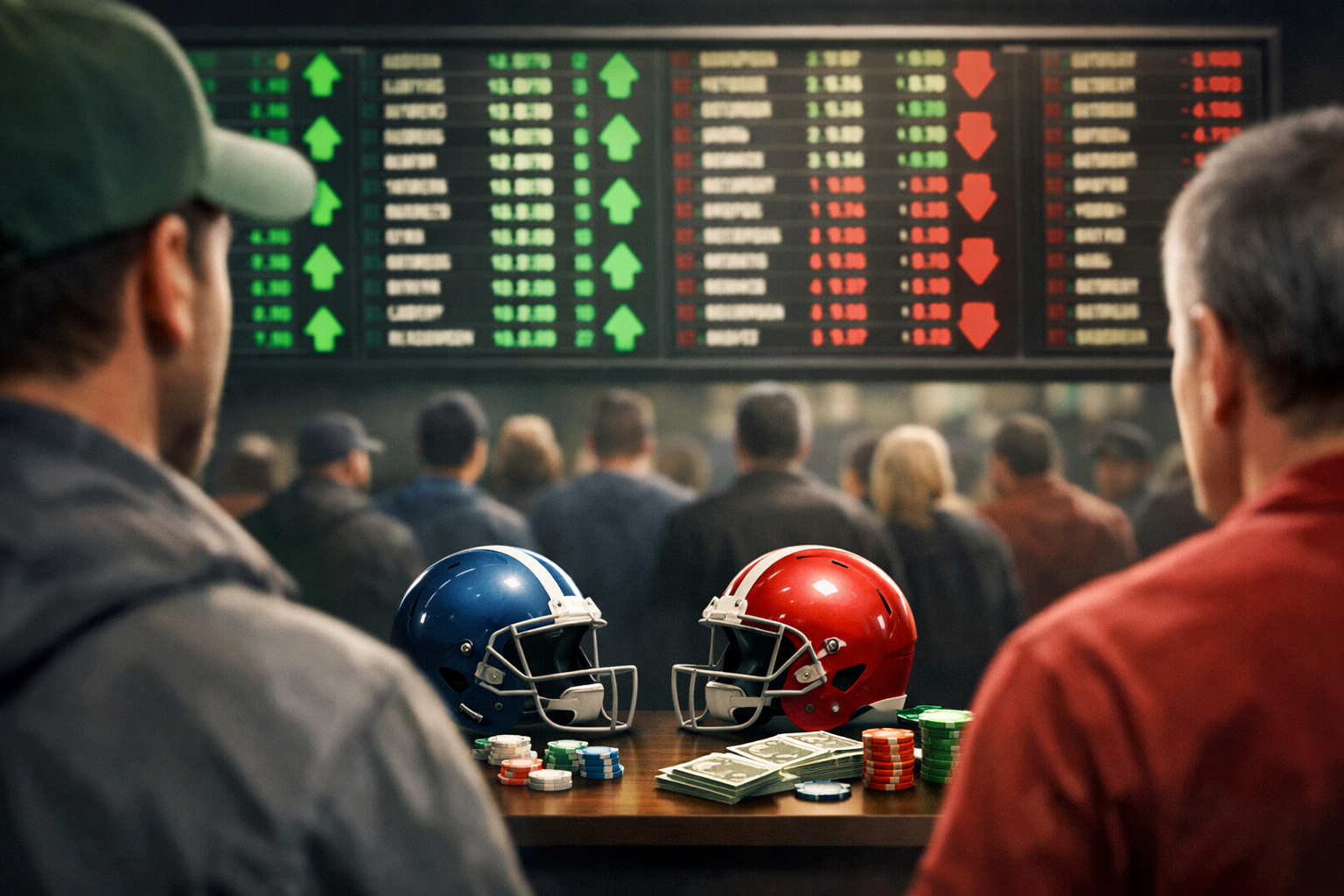
There's a brilliant concept buried in a 1936 economics textbook that every sports bettor deserves to know. Keynes described a newspaper game where readers chose the prettiest face from a set of photographs. You didn't win by having good taste. You won by guessing which face everyone else would pick.
Nearly ninety years later, that same logic runs underneath every point spread posted on a sportsbook's board - and understanding it is one of the best edges a bettor can develop.
What a Spread Actually Tells You
A common assumption is that a -6.5 spread means the book "expects" the favorite to win by a touchdown. It's an intuitive read. But the reality is more useful once you see it.
A spread is a price tag, not a forecast. Oddsmakers function like auctioneers - setting a number that divides opinion roughly down the middle. When money tilts too far in one direction, the number shifts. Not because anyone learned something new about the quarterback's arm, but because the book is balancing its exposure.
What you're looking at when you see a line is thousands of individual judgments, biases, and reactions compressed into a single number. Once you treat it as a market signal rather than a prediction, you start seeing opportunities others walk past. Even if you just create 1xBet account and begin tracking how lines shift from open to close, the pattern becomes hard to unsee.
The Power of Thinking One Level Deeper
Solid matchup analysis - studying quarterback ratings, defensive rankings, rest advantages - is a strong foundation. The bettors who build lasting success take it one step further. They layer market awareness on top of game knowledge, watching whether the money flow has stretched a number beyond what the matchup supports.
An NFL favorite opens at -3. Public enthusiasm pushes it to -4 by Wednesday, -4.5 by Friday. A bettor tracking this migration recognizes the underdog at +4.5 now carries value that didn't exist Monday. The number has moved on sentiment, and sentiment-driven movement creates openings.
This is Keynes in cleats - anticipating where the crowd leans and finding value on the other side. If you follow online football bet markets in real time, you can watch this dynamic play out week after week and sharpen your read on line movement as it happens.
Reading the Signals in Line Movement
Reverse line movement is one of the most rewarding signals a bettor can learn to spot. Three-quarters of public tickets land on the favorite, yet the spread tightens instead of widening. It looks strange until you understand who's in the room.
Sportsbooks don't weigh all dollars equally. When a respected syndicate - a group with a documented edge across years of tracked results - takes a position, the line responds even if public volume points the other way.
Here are the key market signals worth tracking:
- Reverse line movement - Heavy public action on one side, line drifts the other way. Informed money is likely on the unpopular side, creating a potential value window.
- Steam move - Sudden, uniform line shift across multiple books within minutes. Usually a syndicate hitting max limits at several platforms simultaneously - a strong directional signal.
- Buy-back - Sharp money pushes a line in one direction first, then comes back heavier on the opposite side at an improved number. The second move reveals the real position.
- Frozen line - Overwhelming one-sided public action, yet the number holds firm. Respected positions on the other side are keeping it anchored.
Learning to read these patterns adds a whole new dimension to handicapping - one that goes beyond team stats and into market structure.
The Metric That Reveals Your Real Edge
Win-loss records tell part of the story. The metric that tells the rest is Closing Line Value - a comparison between the odds you locked in and the final number posted before kickoff. You took +150, the line closed at +130 - that gap reflects the edge you captured.
What makes CLV such a powerful tool for bettors:
- Speed of signal - Betting analyst Joseph Buchdahl has shown that CLV can surface a meaningful edge in as few as 50 bets, far faster than waiting thousands of wagers for profit-and-loss data to stabilize.
- Timing reward - Industry data shows bets placed 24+ hours before game time capture roughly 1.2% more CLV than last-hour wagers, rewarding preparation and early action.
- Compounding effect - Even a 1–2% CLV edge, stacked across hundreds of bets, builds the kind of consistency that turns a good season into a repeatable one.
The closing line represents the market's most refined opinion - every injury report, weather update, and sharp dollar fully absorbed. Consistently beating that final number means your process is working, and the results will follow.
Two Games, One Ticket
Every wager carries a dual opportunity. One contest plays out on the field - talent, coaching, execution. The other lives in the market - in the space between where the crowd has pushed a number and where the number probably belongs.
The bettors who thrive long-term learned to play both at once. And the second game, as Keynes understood, is the one that keeps rewarding those who study it.
Discussions (0)